
Why Study Culinary Arts? Reasons, Careers and the Reality in India
People study culinary arts to turn an interest in food into a professional craft with real career options. A good programme teaches technique, food safety, costing and kitchen leadership, and opens routes into hotels, restaurants, bakeries, F&B brands and food businesses of your own. It suits people who enjoy discipline as much as creativity.
This guide explains what culinary arts involves, the strongest reasons to study it, what the career looks like in India, how formal training compares with learning on the job, and who should think twice before enrolling. Where we use figures, we name the source and the date.
What Is Culinary Arts?
Culinary arts is the professional practice of preparing, cooking and presenting food, together with the systems that make a kitchen work: food safety, costing, purchasing, menu planning and team management. It covers savoury cuisine and, usually as a specialism, pastry and bakery.
Studying culinary arts means learning these skills in a structured sequence in professional kitchens, then applying them in real workplaces. Degree and postgraduate programmes add business subjects, so graduates can move into management or run their own food ventures.
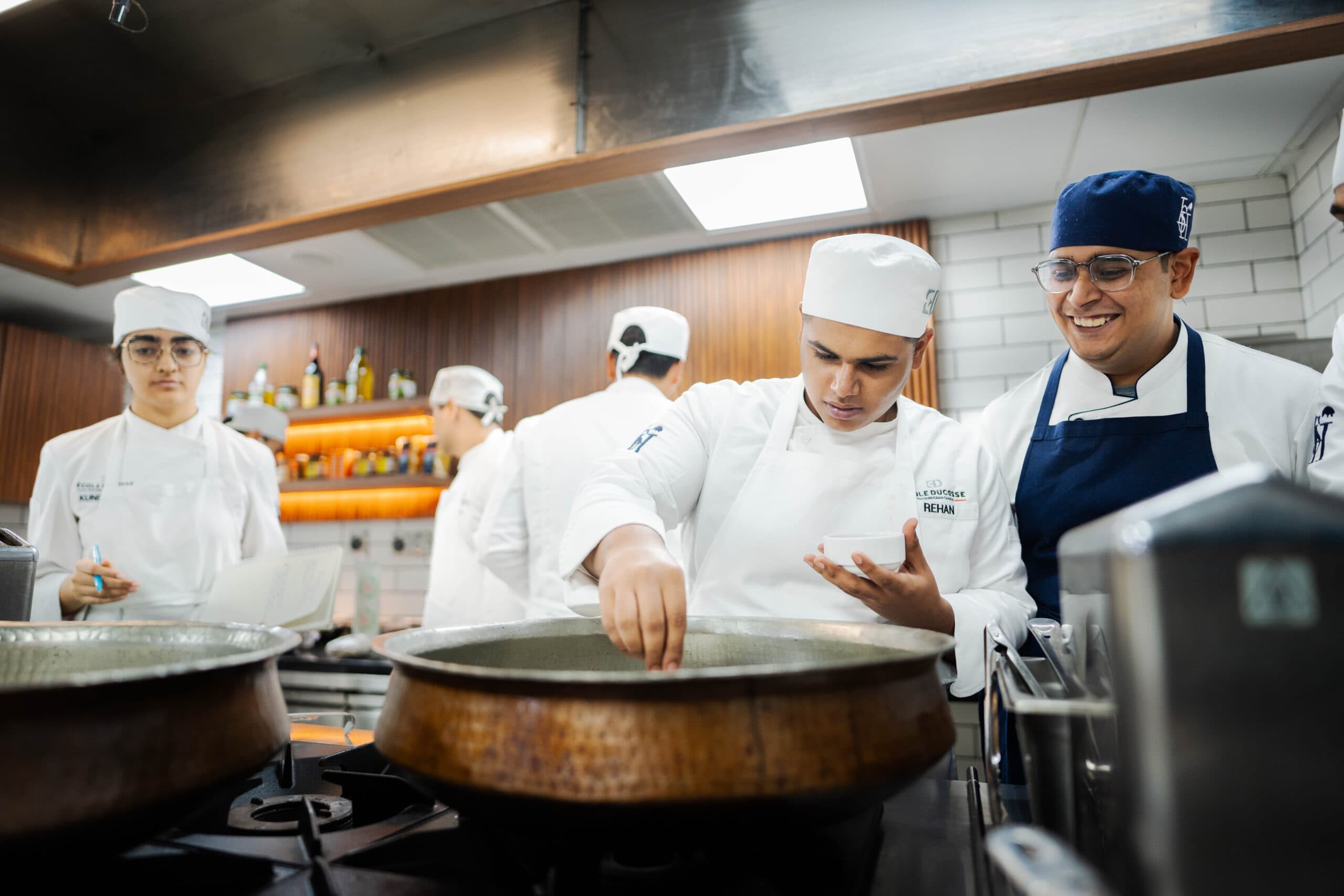
At École Ducasse India, the Indian campus of École Ducasse on the ISH campus in Gurugram, you can study culinary arts through undergraduate and postgraduate programmes, or through dual-campus diplomas that continue in France or Singapore.
Why Study Culinary Arts? Seven Reasons
The strongest reasons to study culinary arts are a hands-on craft you can measure, a large and growing food economy in India, careers that reach beyond restaurant kitchens, a direct route to entrepreneurship, skills that travel internationally, a faster path to kitchen leadership, and work that combines creativity with discipline.
1. You learn a hands-on craft you can see and measure
Culinary education is mostly practical. You build knife skills, mise en place, stocks, sauces, cooking methods and plating, and you are assessed on the dishes you produce, not only on written exams. Progress is visible: a dish is either consistent service after service, or it is not.
For people who learn best by doing, that is a strong reason in itself. Every skill you practise, from portion control to hygiene routines, is used daily in a working kitchen.
2. India’s food services sector is large and still growing
According to the National Restaurant Association of India’s India Food Services Report 2024, the sector was worth about ₹5.69 lakh crore in FY24, directly employed about 8.5 million people, and was projected to reach about ₹7.76 lakh crore by FY28, with the organised segment growing at 13.2% a year.
A newer NRAI and Redseer Strategy Consultants report, reported in July 2026, projects the market to reach about US$150 billion by FY31. It expects organised brands, including quick-service chains, cafés, cloud kitchens and casual dining, to take a growing share of spending. That matters for culinary graduates, because organised operators typically hire into defined roles with training programmes and promotion ladders.
3. The career paths go well beyond restaurant kitchens
Most culinary careers start in a kitchen brigade, moving from commis chef to chef de partie, sous chef and head chef. The same training also leads to many other destinations:
- Hotels and resorts, including banqueting and multi-outlet kitchens.
- Bakeries, patisseries and chocolate businesses.
- Members clubs, catering companies and cloud kitchens.
- F&B brands, product development and food marketing.
- Hospitality education and training.
Many professionals spend their early years cooking before moving into operations, product or brand roles, because kitchen experience gives them credibility with chefs later.
4. It is one of the most direct routes to running your own food business
Many people study culinary arts because they want to open a café, bakery, cloud kitchen or restaurant. Training that covers costing, menu engineering, purchasing, food safety and people management matters here, because those skills often decide whether a food business survives.
In ISH’s Class of 2026, 27% of graduates across its liberal hospitality and culinary arts undergraduate programmes chose entrepreneurship or a family enterprise as their outcome, reported separately from placement. École Ducasse India’s B.A. (Hons.) in Culinary Arts at ISH offers an Entrepreneurship specialisation from Semester 5, in which students design new business ideas and test them with mentors.
Food businesses in India are also regulated. Under the FSSAI FoSTaC programme, food businesses holding central or state licences should have at least one trained and certified Food Safety Supervisor for every 25 food handlers on each premises. Culinary training that takes food safety seriously prepares you for that responsibility.
5. Culinary skills travel internationally
Core cooking techniques and kitchen systems are shared across the world, which makes culinary skills portable. Your right to work in another country still depends on its visa and labour rules, but international training and work experience make the move easier.
Experienced kitchen leaders remain in demand in mature markets. In the United States, the Bureau of Labor Statistics projects employment of chefs and head cooks to grow 7% from 2025 to 2035, with about 25,200 openings a year on average. That figure describes the US labour market only.
At École Ducasse India, the diplomas are dual-campus pathways: the Culinary Arts Diploma continues at École Ducasse Paris, and the Diploma in Culinary Arts continues at At-Sunrice GlobalChef Academy in Singapore, both with a paid internship.
6. Formal training can shorten the path to leadership
You do not need a qualification to cook professionally. The US Bureau of Labor Statistics notes that chefs and head cooks typically need a high school diploma and work experience, and that some attend culinary programmes while others learn through apprenticeships.
What formal training adds is sequence and breadth. You learn foundations, food safety, costing and management in a set order, rather than depending on which kitchen and which chef you happen to train under. That foundation helps when you are ready to run a station, a kitchen or a business.
7. It combines creativity with discipline
Culinary arts rewards creativity, but professional kitchens run on precision, timing and repetition. Chef Manish Mehrotra, quoted on the B.A. (Hons.) in Culinary Arts page, names the values that build great kitchens as “discipline, simplicity, and respect for process”.
If you enjoy getting the same dish exactly right every time, and then finding ways to improve it, culinary arts is likely to suit you.
Why Study Culinary Arts Formally Instead of Learning on the Job?
Study culinary arts formally if you want structured foundations, management skills, a recognised credential or international pathways. Learning on the job can be enough if you already have access to a strong kitchen and mentor, and you do not need a qualification for further study or work abroad.
| Factor | Formal culinary education | Learning on the job |
|---|---|---|
| Upfront cost | Tuition and living costs | Low; you earn from the start |
| Foundations | Taught in sequence: technique, food safety, costing | Depends on the kitchen and the chef |
| Business and management skills | Built into degree and postgraduate programmes | Learned informally, if at all |
| Credential | A recognised qualification for jobs and further study | None |
| International options | Partner campuses and internships abroad | Harder to arrange |
If you are a graduate switching into culinary arts, the one-year PGCM in Culinary Arts at École Ducasse India, ISH combines professional kitchen training with management and entrepreneurship, and ends with a structured work attachment.
Is Culinary Arts a Good Career in India?
Culinary arts can be a good career in India if you are prepared for demanding early years. Pay usually starts modestly and rises through promotion, and the work involves long shifts, evenings and weekends. Graduates who keep building skills can progress into sous chef, head chef, management or business ownership.
Salaries depend on the employer and the career ladder you join. For École Ducasse India’s B.A. (Hons.) in Culinary Arts Class of 2026, ISH’s Class of 2026 Graduate Outcomes report records a median management training salary of ₹3.6 lakh per annum, rising to a median of ₹6.0 lakh per annum on completion of the employer’s training programme, based on confirmed records. That is one cohort at one school, so treat it as a benchmark, not a promise.
Working conditions matter as much as pay. The US Bureau of Labor Statistics describes chefs and head cooks as often working early mornings, late evenings, weekends and holidays in a hectic, fast-paced environment. Before committing, spend time in a professional kitchen to see whether that rhythm suits you.
Who Should Study Culinary Arts?
Culinary arts suits people who like physical, practical work, stay organised under pressure and are willing to repeat a technique until it is right. It suits people less well if they want predictable office hours or expect a senior title soon after graduating.
Culinary arts is likely to suit you if you:
- Enjoy working with your hands and seeing results quickly.
- Stay calm and organised when orders are coming in fast.
- Are happy to repeat a technique until it is consistent.
- Are curious about ingredients, cuisines and how food businesses work.
- Want the option of running your own food venture one day.
Think twice if you:
- Want a predictable nine-to-five schedule.
- Dislike physical work and long periods on your feet.
- Expect a senior title soon after graduating.
- Are drawn mainly by television cooking rather than daily service.
The simplest test is to spend a few days in a professional kitchen or take a short course before committing to a full programme. ISH’s short-term programmes include Explore the Fundamentals of Food, which covers knife skills, pasta, sauces and balance.
Why Study Culinary Arts at École Ducasse India?
École Ducasse India is the Indian campus of École Ducasse, hosted on the ISH campus in Gurugram. Its programmes combine professional kitchen training and chef-mentors with business subjects and structured work attachments with hospitality and F&B brands.
École Ducasse India at ISH — the Indian campus of École Ducasse, named the World’s Best Culinary Training Institution three consecutive times in 2023, 2024 and 2025.
| Programme | Duration and credential | Best suited to |
|---|---|---|
| B.A. (Hons.) in Culinary Arts | Eight semesters; Gurugram University degree, with an optional final year at École Ducasse Paris or ENSP | School leavers who want culinary skill plus a business specialisation |
| PGCM in Culinary Arts | One year over four trimesters; AICTE-approved | Graduates and career changers who want craft plus management |
| PGCM in Bakery and Pastry Arts | One year over four trimesters; AICTE-approved | Graduates focused on pastry, bakery and food ventures |
| Culinary Arts Diploma (École Ducasse Paris) | 12-month dual-campus pathway, India and France | Candidates seeking French culinary training and a paid internship |
| Diploma in Culinary Arts (At-Sunrice GlobalChef Academy) | 16-month dual-campus pathway, India and Singapore; SSG-recognised | Candidates wanting a Singapore pathway and a paid internship |
| Pastry & Bakery diplomas | 12 months (ENSP, Yssingeaux) or 16 months (At-Sunrice) | Candidates focused on pastry, bread and chocolate |
ISH reports on its Impact in Numbers page that 80% of its students are supported through need-based scholarships, and that about 25% have progressed to Les Roches and École Ducasse for second degrees at undergraduate, diploma and postgraduate levels.
Common Misconceptions About Studying Culinary Arts
- “Culinary arts is just cooking.” It also covers food safety, costing, purchasing, menu planning and team leadership.
- “A culinary qualification makes you a head chef.” It speeds up your foundations; senior titles still come from years of performance.
- “Culinary careers mean restaurants only.” Hotels, bakeries, clubs, catering, F&B brands and education all hire culinary talent.
- “You must already be a skilled cook to enrol.” Good programmes teach foundations from the start, including classical techniques, knife skills, mise en place, stocks and sauces.
- “Passion is enough.” Stamina, reliability and consistency matter just as much in the first years.
Frequently Asked Questions
Why should I study culinary arts?
Study culinary arts if you want to turn an interest in food into a professional craft with real career options. Good programmes teach technique, food safety, costing and kitchen leadership, and lead to roles in hotels, restaurants, bakeries, F&B brands and food businesses of your own. It suits people who enjoy discipline and repetition as much as creativity.
Is culinary arts a good career in India?
It can be, if you accept demanding early years. India’s food services sector directly employed about 8.5 million people in 2024, according to NRAI. Pay usually starts modestly and rises through promotion; for ISH’s B.A. (Hons.) in Culinary Arts Class of 2026, the median rose from ₹3.6 lakh per annum during training to ₹6.0 lakh per annum on completion.
What do you learn in a culinary arts programme?
You learn cooking techniques, knife skills, mise en place, stocks and sauces, pastry foundations, plating, food safety and kitchen discipline. Degree and postgraduate programmes add business subjects such as costing, operations and entrepreneurship, plus structured work attachments where you apply your training in real hospitality and F&B workplaces.
Do I need culinary school to become a chef?
No. Many chefs learn on the job, and the US Bureau of Labor Statistics notes that chefs and head cooks typically need a high school diploma and work experience. Culinary school is a faster, more structured route that adds management skills, a recognised credential and international pathways, which help if you want to lead kitchens, study further or work abroad.
Can I study culinary arts after Class 12?
Yes. School leavers can apply to undergraduate programmes such as École Ducasse India’s B.A. (Hons.) in Culinary Arts at ISH, an eight-semester Gurugram University degree that combines culinary and pastry techniques with business subjects and two structured work attachments. Check each programme’s admissions page for current eligibility requirements.
Is culinary arts only about working in restaurants?
No. Culinary graduates work in hotels and resorts, bakeries and patisseries, members clubs, catering companies, cloud kitchens, F&B brands, product development, food marketing and hospitality education. Many start in a kitchen because that experience gives them credibility later, then move into management, brand or business roles.
Next Step: Test Your Interest, Then Compare Programmes
If culinary arts appeals to you, test it before you commit: spend time in a professional kitchen or take a short course. Then compare programmes on credential, kitchen time, work attachments, international options, total cost and verified graduate outcomes for their most recent culinary cohort.
To explore the options at École Ducasse India on the ISH campus in Gurugram, see the B.A. (Hons.) in Culinary Arts, the postgraduate certificates in Culinary Arts and Bakery and Pastry Arts, and the diploma programmes, or start your application.
Browse by category
Tags